Additional China resources
Understanding how economics, politics and government intersect can help businesses navigate China’s market with confidence. This chapter outlines key institutions, economic zones, essential contacts and support resources for business success.

Country information
Politics and government
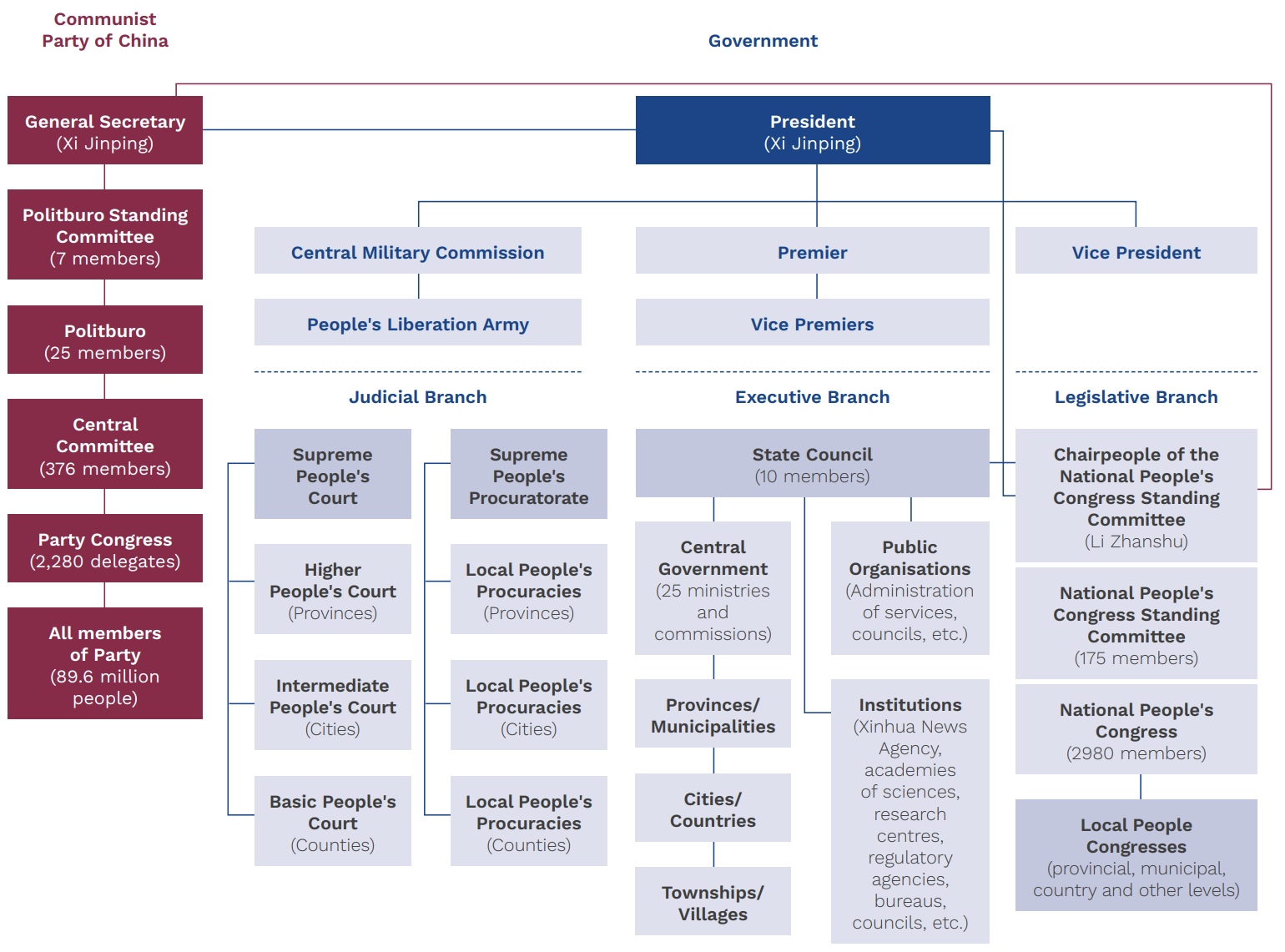
China is a one-party state, ruled by the Chinese Communist Party (CCP) since 1949. The party consists of 99 million members dominating every part of China’s political system. China is divided into 34 administrative divisions, consisting of 23 provinces, four municipalities, five autonomous regions and two special administrative regions.
Xi Jinping is the president of China and the general secretary of the CCP. He is one of seven members of the Politburo Standing Committee, whose members are the most senior in government. The Politburo has 17 other members in addition to those on the Standing Committee. They sit above the National People’s Congress, which has about 3,000 delegates.
Additionally, an informal body in the political system, colloquially referred to as the “party elders” has traditional exerted considerable influence over the political process in China, although that influence has waned over the past decade. Political processes in China remain opaque.
Legal system
China’s legal system is also run by the Communist Party. It is comprised of seven categories – civil and commercial, administrative, economic, social and criminal laws, and the law on lawsuit and non-lawsuit procedures. These categories are then divided between state laws, administrative regulations and local statutes.
The judicial system is comprised of three branches: the courts, prosecuting authorities and public security. The National People’s Congress exercises authority over the three branches and the legal system lacks judicial independence. The country’s unified court system has four levels: the Supreme People’s Court (SPC) and three levels of local courts (high, intermediate and basic). The SPC is the top court in the country and has the final authority to pass legally binding decisions; it is also a supervising organ of trial systems at all levels.
The court has three permanent divisions: civil, criminal and economic. Other divisions are created when required. Within the civil division, there are sub-divisions. The 4th Civil division deals with all cases concerning foreign law and parties.
China’s courts are controlled by the Communist Party, and this reflects in the country’s unusually high conviction rate of 99.9 per cent, indicating that the judicial system is not fair.
China’s Government and Judicial Structure
Key government agencies
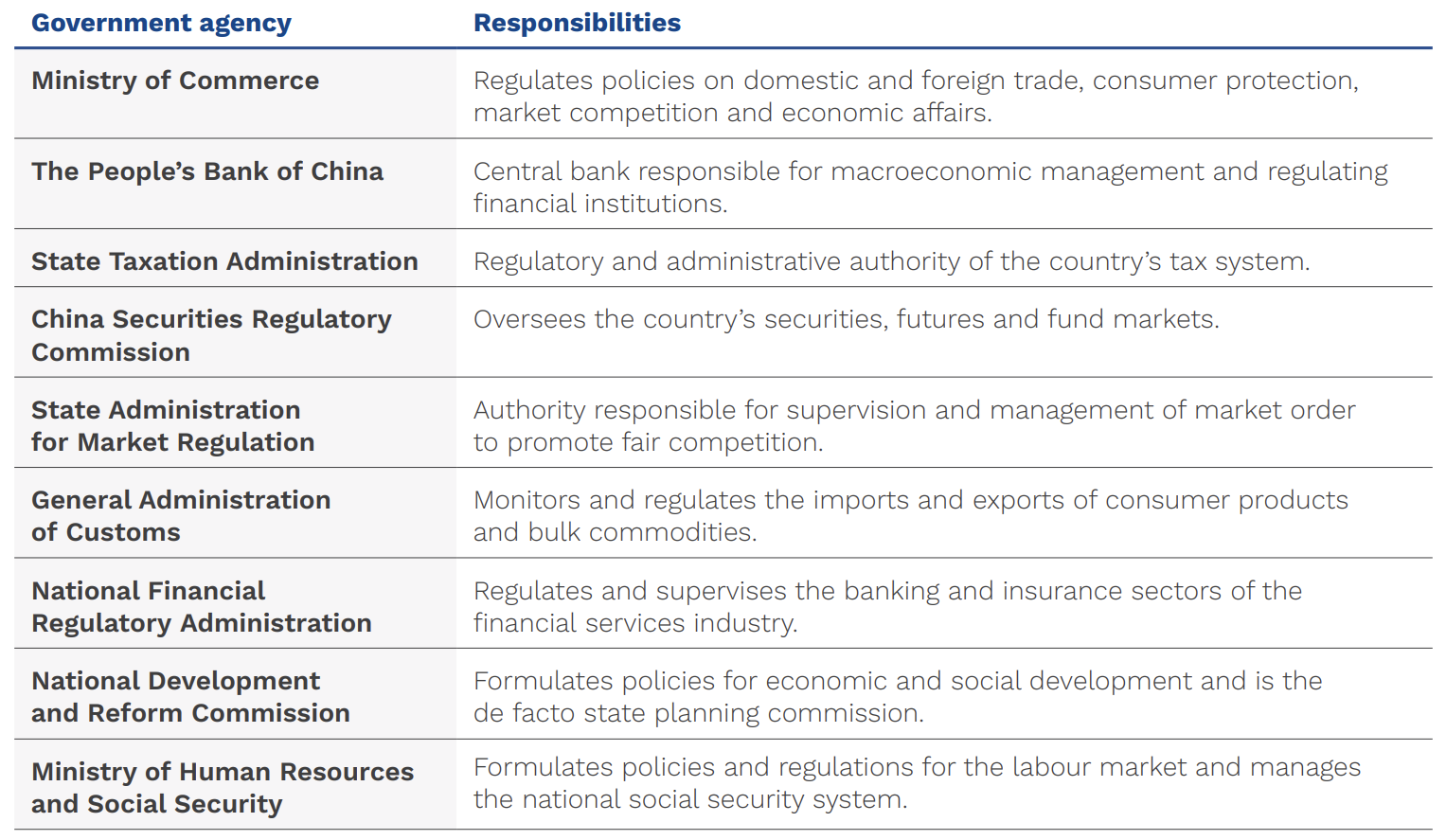
Key government agencies and industry associations will need to be consulted throughout the process of setting up a business in China. Some of these agencies can also be useful for providing advice and initiating contacts.
The main agencies and their areas of authority relating to foreign businesses are:
Key economic areas
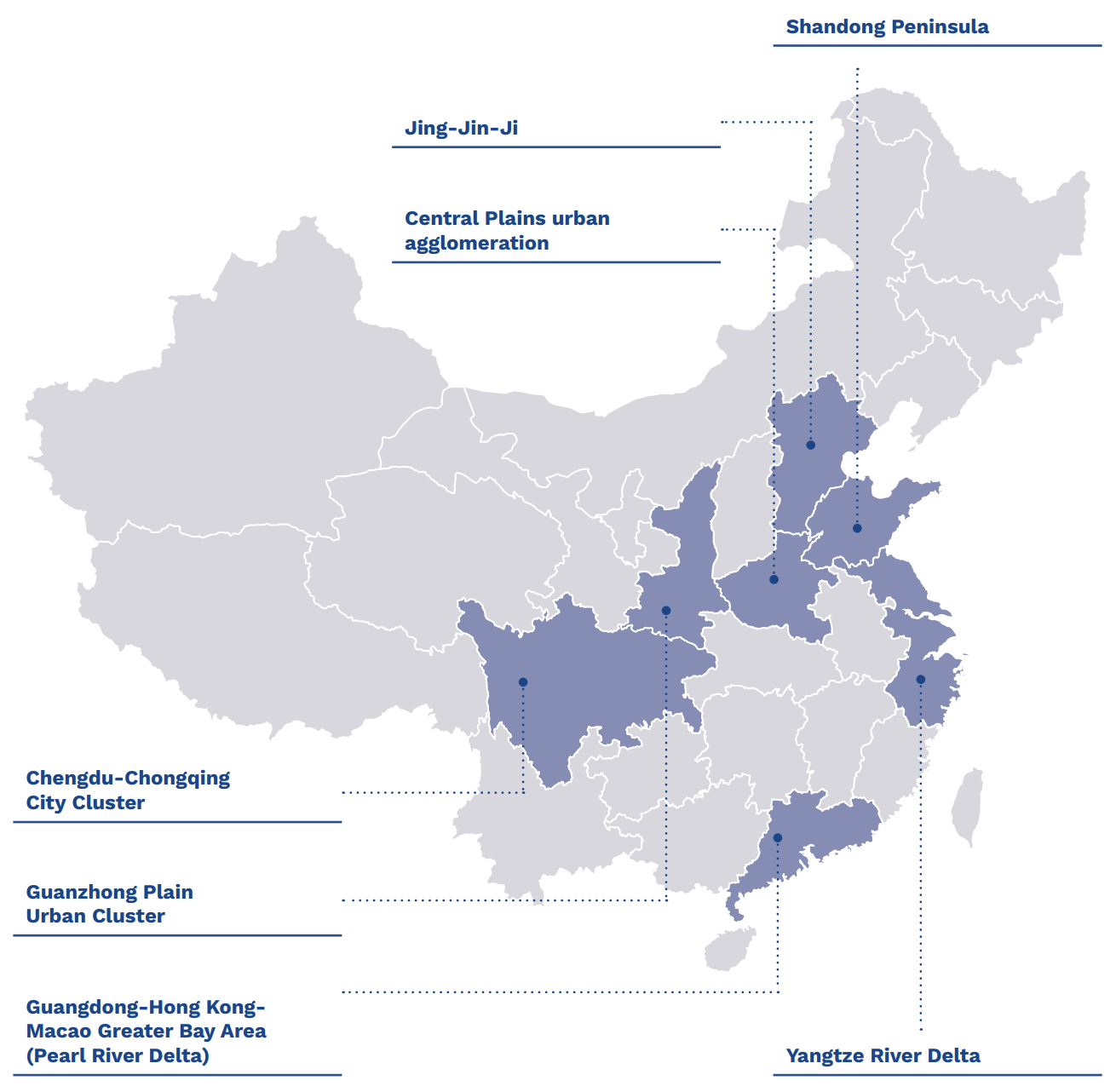
Much of China’s economic growth is driven by a handful of urban clusters where economic activity is concentrated. These clusters are expected to continue providing opportunities for growth for Australian (and other) businesses:
Jing-Jin-Ji: The economic cluster comprises Beijing, Hebei province and the city of Tianjin. The cluster has a population of more than 100 million and accounts for a GDP of AUD 2.46 trillion (CNY 11.5 trillion) in 2024. It is a key talent hub and key industries are power equipment, network security, biopharmaceuticals and integrated circuits. The region also aims to develop capabilities in artificial intelligence, robots, aerospace technology and intelligent electric vehicles.
Yangtze River Delta: This economic cluster encompasses Jiangsu, Shanghai municipality, Zhejiang and Anhui provinces. The region has a population of more than 240 million and despite comprising only about 4 per cent of China’s land area accounts for a quarter of the country’s GDP. The area is a major automobile production base and supports the technology industry with a range of engineering centres, national laboratories and universities. Cities in the Yangtze River Delta have a concentration of technological research and development, an innovative culture assisting high tech industries. The region’s technological prowess and focus on green energy opens up opportunities for Australian businesses in the education sector, medical technology, renewable energy and electric vehicles.
Guangdong-Hong Kong-Macao Greater Bay Area (Pearl River Delta): This economic cluster comprises Hong Kong and Macao, and nine municipalities: Guangzhou, Shenzhen, Zhuhai, Foshan, Huizhou, Dongguan, Zhongshan, Jiangmen and Zhaoqing. The region has a combined population of more than 86 million and represents around 10 per cent of China’s GDP. It is both a technology and innovation hub, and a leading trade and logistics hub, which also opens opportunities in areas like smart infrastructure and smart logistics. The Greater Bay Area presents opportunities for Australian businesses in areas including tec.
Chengdu-Chongqing City Cluster: The economic cluster comprises Chengdu, 14 Sichuan cities and 27 districts in Chongqing. The region has a population of 98 million and a GDP of AUD 1.8 trillion (CNY 8.6 trillion) in 2024, accounting for over 6.5 of the country’s total. Energy production is a major activity in this cluster with a focus on hydroelectric power and natural gas. The region has a strategic location with a strong logistical network via road, rail and sea for movement of goods offering opportunities for international trade. Being a major supply chain hub, the region can attract Australian businesses to setup in the region. The cluster also presents opportunities for Australian businesses in energy sector.
Yangtze River Middle Reaches City Cluster: This cluster is set up around the three cities of Wuhan, Changsha and Nanchang, and 28 other cities in the provinces of Hubei, Hunan and Jiangxi. Located in central China, this cluster is one of China’s largest in terms of population and contribution to GDP.
Guanzhong Plain urban cluster: The cluster comprises 11 cities and the provinces of Gansu, Shaanxi and Shanxi. The region had a population of 40.4 million and a regional GDP of AUD 513 billion (CNY 2.4 trillion).
Hainan Free Trade Zone: Hainan Free Trade Port (FTP) will roll out zero-tariff and customs closure policies on December 18, 2025, creating a more efficient and open trade environment. These changes are expected to accelerate the port’s development into a global trade hub. More information is available here.
China-Australia bilateral relationship
Australia and China established diplomatic relations in 1972. It is a relationship based on shared economic and trade interests and strong cultural links. While there have been political differences to manage in recent years, economic ties have generally remained strong and China continues to be Australia’s most important, and largest, trading partner.
The long-term trend has been one of growing economic engagement between the two countries, and several Chinese trade impediments that had impacted Australian exports to China since 2020 have been removed.
The China-Australia Free Trade Agreement (ChAFTA) came into force in December 2015 deepening trade and investment ties between the two countries. The two countries are also both party to the Regional Comprehensive Economic Partnership (RCEP), an FTA between 15 Asian economies.
Each year, Australia and China hold high level meetings with representatives from government, academia and industry to develop shared interests in agriculture, trade and tourism, defence, education and climate change.
Further information on the bilateral relationship between the two countries is available from DFAT.
Useful contacts and support resources
Government organisations
Australian Department of Foreign Affairs and Trade (DFAT)
DFAT manages Australia’s international network, including in China. Australia has an Embassy in Beijing, and Consulate-Generals in Shanghai, Guangzhou, Chengdu and Hong Kong.
Australian Trade and Investment Commission (Austrade)
Austrade is the Australian Government agency responsible for facilitating international trade and investment. Austrade can provide advice on the market, potential in-market partners and export marketing services. Austrade has offices in Beijing, Chengdu, Guangzhou, Hong Kong, Shanghai and Shenzhen.
Export Finance Australia (EFA)
EFA provides information, support and export finance solutions to Australian businesses looking to expand overseas.
State government agencies
Many state government agencies have representatives or offices in China, including New South Wales, Queensland, South Australia, Tasmania, Victoria, Western Australia.
Business and industry associations
The Australian Chamber of Commerce in China represents and promotes Australian businesses operating in China. AustCham coordinates a regular program of business seminars, networking and social functions for the business community in China.
The Australia China Business Council
The Australia China Business Council promotes bilateral trade and investment opportunities between Australia and China. In addition to networking and cultural awareness programs, it offers a B2B supply chain consultancy service for Australian businesses looking to enter China.
The Export Council of Australia is the peak industry body for the Australian export community.
Programs and support
Information, tools and support to grow your business globally through a range of digital for every stage of the export journey.
Export Market Development Grants (EMDG)
Austrade seeks to help small to medium Australian enterprises grow their exports in international markets through their EMDG grant program.
The Industry Growth Program supports innovative SMEs undertaking commercialisation or growth projects in the National Reconstruction Fund priority areas.
The Asia Pacific Economic Cooperation (APEC) Business Travel Card scheme can facilitate travel entry processes for short-term business travel in APEC economies.
References
A select list of sources used in the development of this publication are included below.
Asia Law Network
Asian Development Bank
Association of Banks in Singapore
Australian Department of Foreign Affairs and Trade
Australian Institute of International Affairs
Australian Trade and Investment Commission (Austrade)
Boston Consulting Group
Dezan Shira and Associates
DBS
Economist Intelligence Unit
Euromonitor
Export Finance Australia
EY
Freedom House
FitchRatings
Heritage Foundation
HSBC
IMF
International Comparative Legal Guide
International Energy Agency
International Federation of Accountants
International Forum of Independent Audit Regulators
KPMG
McKinsey & Company
Ministry of Commerce, China
Ministry of Ecology and Environment, People’s Republic of China
PWC
Tech in Asia
The Heritage Foundation
Transparency International
S&P Global
State Administration of Foreign Exchange (SAFE), People’s Republic of China
United Nations Council of Trade and Development
US Chamber of Commerce
US Department of State
US International Trade Administration
China Government (various sources)
Transparency International
We Are Social
World Bank
A note on currency
All money amounts are in Australian dollars unless otherwise indicated.
Exchange rate used is the historical rate for the previous twelve months.
AUD 1 = USD 0.648
AUD 1 = CNY 4.676
Acknowledgements
Asialink Business gratefully acknowledges the assistance and information from the following organisations in the production of this Doing Business Guide:
Department of Foreign Affairs and Trade
Andy Jiang
Jonathan Cox, Stratforms
Guy Thompson, United Media Solutions
Several businesspeople provided anonymous review. We extend to them our sincere appreciation.
Asialink Business is supported by the Australian Government’s Department of Industry, Science and Resources and the University of Melbourne.
Disclaimer
This publication contains country and industry general information and does not address the circumstances of any particular individual or entity. While all efforts have been made by Asialink Business to ensure that the data and information provided herein are accurate, the accuracy of the information in the future cannot be guaranteed.
Users of this document should undertake their own independent analysis and obtain appropriate professional advice, if required, before acting upon such information in any given situation. Asialink Business accepts no liability for any loss which may arise from the use of the information contained in this publication.
Reproduction of any part of this publication without prior written approval of Asialink Business is strictly prohibited. The information in this document is accurate as of October 2025.