Understanding China
Success in China begins with understanding its unique business culture, economic structure, and regulatory landscape. This chapter outlines the key factors shaping China’s market and what they mean for Australian businesses.

Business Culture
Cultural intelligence is key to achieving sustainable business outcomes. Being able to read cultural clues and respond appropriately helps develop relationships, communicate effectively and build trust. While cultural and communication norms are changing as virtual modes of engagement increase, core cultural values remain an important factor in business. Not understanding the particularities of doing business in China could lead to missed opportunities, delays and lost engagements.
Communication
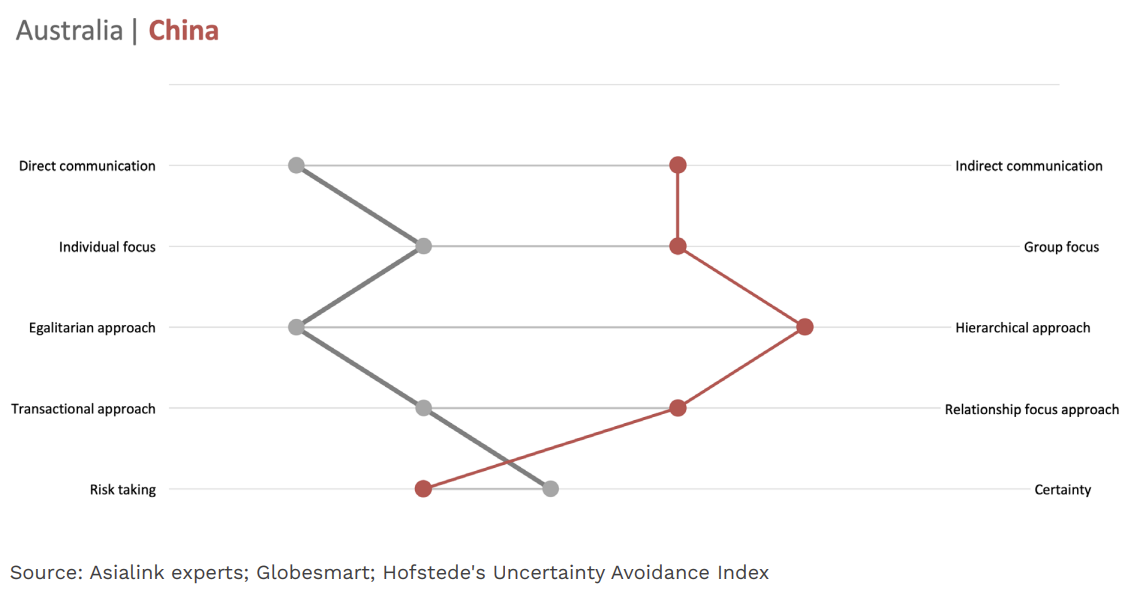
In the Chinese language, communication can be indirect and heavily reliant on context, especially when a new relationship is established. In English, by contrast, people rely on the clarity of their message to communicate. This difference in style is also apparent in Chinese business culture. Chinese people may use ambiguous language and understatement to preserve harmony in their interactions. To save face, subtle non-verbal cues such as expressions, gestures and silence may be used to express disagreement rather than an outright refusal. It is polite to adopt similar non-verbal cues. Indirect eye contact is also an indicator of respect for a more senior person. Avoid self-deprecating humour or sarcasm and maintain both physical and emotional composure.
Meetings often begin with a more formal structure than is typical in Australia. Attendees will enter a meeting and carry out introductions in order of importance or ranking. Meeting participants are expected to be greeted individually, no matter the size of the group.
Presenting and receiving business cards using both hands indicates respect in China. Rather than immediately putting business cards away, place them on the table in front of you when sitting to indicate you are considering the information. Also, consider arranging the business cards if on the table in order of the hierarchy. It is advantageous to print Australian business cards with English on one side and Chinese on the other.
Navigating culture in business – the importance of core cultural values
Communicating via WeChat
WeChat, a ‘super app’ that provides instant messaging, video conferencing, file sharing, mobile payments and much more, is a critical tool for any business operating in China. Day-to-day business communication is often conducted via WeChat rather than email, and it is important to have a WeChat account. Many Western-owned messaging apps such as WhatsApp, which are commonly used for business communications in other parts of Asia, are inaccessible in China. Business contacts will commonly ask to connect with you on WeChat. Once you are connected, share a digital copy of your business card via the app.
Relationships
Building deep relationships is essential to doing business in China. Fostering connections and trust with Chinese counterparts is vital for establishing long-term business opportunities. In practice, this may take time, and negotiations may appear drawn out in contrast to faster-paced business environments. Interpersonal negotiations are favoured over swift, depersonalised contractbased negotiations. Deals may be finalised in informal settings over meals or drinks. Establishing relationships with senior representatives and demonstrating patience, rather than rushing to close a deal, will produce better outcomes in China.
Maintaining face is an important consideration for doing business in China. Losing face can result in a breakdown of relationships and unfavourable business outcomes. It is important to remain respectful and avoid loss of face. The Chinese business culture values harmony, and people are often reluctant to confront or refuse directly. A concern for social roles, respect and harmony influence communication and impact on business.
Guanxi, a term referring to a network of business or social relationships, has long been an essential element in Chinese relationships. Guanxi obliges both parties to do favours or provide connections for each other. Yet it is becoming less important among younger generations.
Hierarchy
Chinese culture emphasises hierarchy, requiring respect for elders and those in seniority in personal and professional settings. Entering and exiting a room according to hierarchical order and planning seating according to hierarchy is considered polite. Hierarchy also determines how decisions get made and often it will be the most senior person who leads the discussions. Junior employees will only speak if they are invited to by their leaders.
The importance of partnerships
Successfully navigating the Chinese business landscape often requires local talent, knowledge and expertise. Partnerships form an important model for doing business.
Building a partnership requires having relationships in place that can facilitate introductions. Introductions from Federal and State Government in-country representatives and trusted intermediaries can help Australian businesses build initial relationships and initiate first-round discussions on possible future deals
After identifying a potential partner, it is essential to conduct due diligence. Due diligence on partners requires understanding their customers and clients, their reach across China’s increasingly complex markets, support for product localisation and inmarket reputation. It is essential to undertake reference checks and risk assessments before formalising local partnerships.
The strength of a local partnership brings advantages across multiple aspects of a commercial operation – from procurement and contracting to gaining credit. Importantly, a local partner can often assist with bureaucratic requirements, including company and product-specific registration processes. Austrade can help identify potential partners in China (details can be found in Section 5.2).
For a more detailed understanding of business culture, business etiquette, and building long-term and sustainable partnerships to deliver strong business outcomes, visit the Asialink Business Academy.
Managing risks
While China offers opportunities for informed and well-prepared Australian businesses, doing business overseas can involve a range of new risks. These should be identified and mitigated as much as practicable – and managed carefully once business operations are established.
Economic: Including the potential for government default (sovereign risk), trade policy, fiscal, monetary and exchange rate risk.
China’s economy is relatively stable. Export Finance Australia considers China's overall investment risk to be low, although trade restrictions have impacted market access for a range of Australian produce. However, heavily indebted state-owned enterprises and companies increase economy-wide risk.In response to weakness in the property sector and rising debt levels, Fitch revised China’s A+ sovereign credit rating to A in 2025. S&P gives China’s short-term outlook an A-1 rating, with the expectation it will rise to A+ longer term.
Following a period of depreciation after the COVID-19 pandemic, China’s yuan mostly recovered but remains weakened against the US dollar. China restricts currency convertibility and controls cross-border capital flows.
Potential mitigations for trade restrictions include diversification to other markets while foreign exchange risk could be addressed through forward contracts, foreign currency options and utilising foreign bank accounts and loans. Seek advice on your level of risk and potential mitigations.
Corruption: Including the potential for bribery, embezzlement and conflicts of interest.
China scores 43 out of 100 on Transparency International’s Corruption Perceptions Index. Despite recent anti-corruption efforts, the persistence of corruption adversely impacts its business environment and poses risks for companies operating in China. Anti-corruption efforts and the digitalisation of public administration have helped to streamline and institutionalise the Chinese bureaucracy in recent years.
You should familiarise yourself with Australia’s foreign corruption and bribery legislation and ensure you have a robust anti-corruption strategy before entering any foreign market. The Australian government recommends that businesses resist making facilitation payments, which are often difficult to distinguish from bribes.
Political - Including the potential for political instability and restrictive government policies.
The potential for instability is low as the Chinese Communist Party maintains control of the state and military. The Chinese Government tightly controls media and public discourse and prohibits political opposition. Localised protests occur occasionally in response to domestic issues.
Business should consider conducting political risk due diligence to understand the political exposure and affiliations of potential partners. You may also wish to explore political risk insurance as a potential mitigation.
Regulatory - Including the potential for regulations that increase the cost of doing business, reduce the attractiveness of an investment or change the competitive landscape.
Navigating China’s evolving regulations, registration, licensing and permit systems can be challenging. Consumer goods categories are subject to frequent regulatory change making compliance time-intensive and costly. China’s foreign investment regime remains restrictive. According to the Heritage Foundation’s 2025 Index of Economic Freedom, China’s overall score fell during the COVID-19 pandemic, with the country dropping from ‘mostly unfree’ to ‘repressed’ on an overall score of 151 out of 184 countries.
Austrade and state government trade bodies, along with trusted local partners, can help businesses understand and navigate China’s complex and evolving regulatory landscape.
Intellectual property (IP) - Including the potential for weak or underdeveloped IP protections and enforcement mechanisms.
Although China has improved its intellectual property (IP) protection framework, IP infringement remains a challenge. Counterfeit and copycat products are prevalent, undercutting market prices and eroding sales. Foreign companies are subject to the Chinese Government’s discretion in granting technology transfer arrangements and licensing infringement remain a concern for patent holders. The US Chamber of Commerce ranks China 24th out of 55 nations in its 2025 International IP Index.
Registration for patents, trademarks and copyrights can help mitigate IP risk. Trademarking both English and Chinese names is essential Continual product development and brand updates can deter counterfeiting. There are also technology solutions such as RFID tags and QR codes to authenticate products.
Supply chain - Including the quality of infrastructure, levels of corruption, corporate governance, supply chain visibility and timeliness.
While supply chain resilience levels vary across China’s regions, its risk rating is relatively high. China’s distribution and logistics infrastructure is advanced but there are risks around environmental issues and modern slavery. China’s imposition of trade impediments on a range of Australian commodities between 2020-22 demonstrated the speed at which the business operating environment can change.
Potential mitigations include supplier diversification, holding additional inventory, implementing new operating models and processes, and using Hong Kong as a hub for supply chain management. Technology is also providing improved analytics, sensors and automation.
Geopolitical - Including the potential for trade relationships, security partnerships and territorial disputes to impact business activities.
Australia and China share historic and cooperative bilateral ties, however both countries acknowledge that there are also big differences to manage. S&P Global rates US-China Strategic Competition as a global source of geopolitical risk. The IMF notes that geopolitical tensions, including the economic decoupling of China and the United States, may have an impact on global trade and investment.
Boards and leadership teams should familiarise themselves with geopolitical issues that may impact your business and, if relevant, develop plans in response to potential scenarios. You may also wish to seek external advice. Some larger businesses manage their level of exposure to China in their global portfolio.
Climate - Including the potential for extreme weather events and rising sea levels to impact trade routes, supply chains and infrastructure.
China is relatively vulnerable to climate change but also increasingly well prepared. The most severe risks to China’s economy and population stem from the country’s vulnerability to drought, flooding and heatwaves. These risks are likely to affect the agricultural sector and may disrupt supply chains. In response, the Chinese Government has set carbon emissions targets and adopted climate resilience strategies including the development of heat-resilient crops and better forecasting of extreme weather events.
Identifying and mitigating climate change risks–including their socioeconomic consequences–should be embedded in all elements of your strategy and operating model.