Why China
China is transitioning toward sustainable, innovation-led growth driven by technology, domestic consumption and the green economy. Despite challenges, Australia’s trade and investment relationship with China continues to present strong opportunities.

Economy overview
Four decades of economic reform have driven widespread industrialisation and lifted hundreds of millions of Chinese people from poverty. The country’s Gross National Income per capita increased more than tenfold between 2004-2024, and the World Bank now considers China an upper-middle-income nation. With a population of 1.4 billion people, China has the world’s largest middle class, making it an attractive (if competitive) market for exporters. Income growth has radically changed consumption habits. As more households enter the middle class, spending on apparel, packaged foods and consumer electronics is rising.
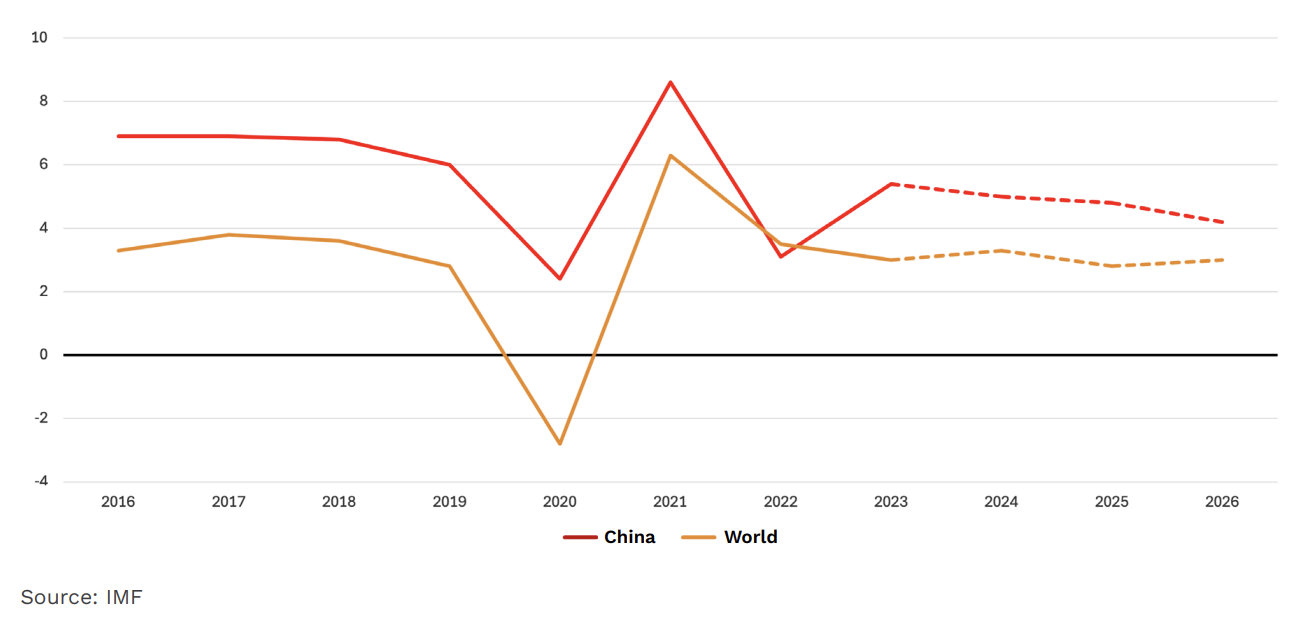
Yet, while China’s economy continues to expand, growth is moderating as the country’s economic development trajectory changes. From routinely witnessing double-digit GDP growth from a low base, China is now expected to see lower growth of between 4.8 per cent in 2025 to 3.5 per cent to 2030.
China’s economy is moving from largely being a manufacturing and export centre to one in which growth is based on domestic consumption, innovative business models and a move up to higher value- added growth.
As China’s economic trajectory changes, future growth will be driven by its rapidly developing technology and services sectors. The government’s most recent five-year plan emphasises technology and sustainability-led economic development. It is investing heavily in what China calls its ‘New Quality Productive Forces’ including
clean energy technologies, with solar and wind power capacity expanding significantly. Chinese trade in its “new three” industries – solar cells, lithium batteries and electric vehicles - grew by 30 per cent in 2023 and continue to grow.
However, China continues to play a critical role in global manufacturing value chains. This role is evolving as multinational businesses diversify their supply chains following the COVID-19 pandemic and due to geopolitical concerns. Yet China’s role in global manufacturing supply chains remains resilient.
At the same time, China’s labour market – the largest in the world – is undergoing dynamic changes. A declining population, stemming from an ageing workforce and low birth rates is resulting in labour market challenges. Separately, as China moves up the technology and manufacturing value chains, there is a need for a more skilled workforce.
The China–Australia Free Trade Agreement (ChAFTA) has been in place since 2015. China and Australia are parties to the Regional Comprehensive Economic Partnership, a regional free trade agreement that includes 15 countries across the Indo-Pacific region. These agreements have boosted Australia’s competitive position in the Chinese market.
This Doing Business Guide applies to mainland China only, excluding Hong Kong SAR, Macau SAR, and Taiwan ROC. For information about these markets, please see the Hong Kong SAR and Taiwan ROC Doing Business Guides.
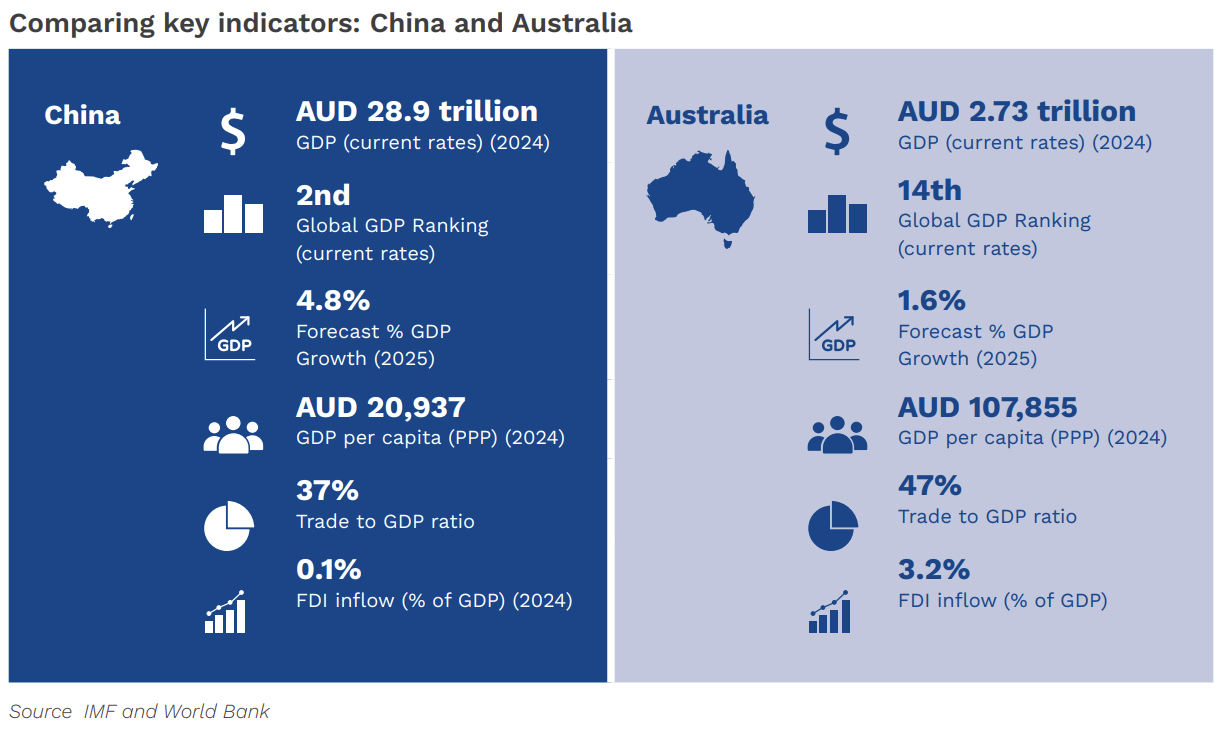
China and Australia also share strong bilateral ties underpinned by trade, community and cultural links. Despite there being differences to manage, both countries are seeking new opportunities to grow economic ties. Goods exports to China fell 10.2 percent in 2024, accounting for 30.4% of Australia’s overall exports in 2024. Despite the dip in 2024, this still represents a 22.4% increase over four years. Australian goods and services exports to China were worth AUD 196 billion (CNY 916.5 billion) in 2024. In 2024, minerals and fuels remained the largest export sector, representing the majority of Australian goods exports to China. Iron ore (AUD 104.8 billion), natural gas (AUD 20.9 billion), and coal (AUD 12.5 billion) were the leading export commodities.
Australian businesses that export to China must remain aware that geopolitical issues could impact trade and investment links in the future. Performing due diligence and assuring data security will be important for Australian companies doing business in China. However, difficulties in accessing information can make performing due diligence challenging for foreign businesses. Another medium-term risk is China’s ageing population, which could slow productivity and impact the workforce. Conversely, this also makes China a potential market opportunity for Australian healthcare and complementary medicine businesses.
More information on the bilateral relationship between China and Australia is available in Section 5.1 and from the Department of Foreign Affairs and Trade’s China Country Brief.
Figure 1: Real GDP Growth - China and world average (2016-2026f), %
Sectoral snapshots
As Australia’s largest trading partner, China is a well-established market for many Australian businesses. Australian raw materials have long been critical to China’s industry-led growth model. The complementarities between the two economies mean that demand for resources, minerals and other commodities will likely remain strong. New opportunities are emerging, too. In mid-2024, China’s government announced it would prioritise the stable development of the real estate sector, emerging and future industries, and increasing domestic consumption. This section provides a short overview of prospective sectors.
Food and agribusiness
China has historically been Australia’s largest export market for agriculture, forestry, and fisheries. Restrictions on some Australian agricultural products, including beef, wine, barley and lobster, imposed between 2020 and 2022 saw overall agricultural exports drop. These have since picked up, exceeding 2019 levels by 2024. Rising incomes in China continue to increase demand for quality food products, including fresh food and discretionary products such as wine. Australian businesses have an opportunity to cater to changing Chinese consumer preferences favouring sustainability and quality assurance. Australian agrifood produce continues to be seen as safe and high-quality. Austrade has identified opportunities in grains, pulses and feed, horticulture, meat and livestock, packaged foods, seafood and aquaculture.
Health and medical
China’s healthcare market has grown significantly over the past decade, supported in no small measure by rapidly increasing government health spending per capita on healthcare, which increased by a factor of nine between 2005 and 2021. The government’s “Healthy China 2030” initiative will further increase demand for healthcare services, including e-health solutions, hospital management systems, and training programs for healthcare providers. As China’s population ages, the need for age-related medical care, aged care, mental health services and chronic disease management will increase. Australian aged-care providers are already tapping into this opportunity by forming joint ventures or partnering with local companies to develop aged-care centres and senior living communities. Complementary medicines such as health supplements are a wellestablished and growing market with an estimated value of AUD 8.2 billion (CNY 38 billion) in 2025. Austrade has identified opportunities in biotech, health services and complementary medicine.
Green economy
China aims to reach peak carbon dioxide emissions by 2030 and become carbon neutral by 2060. Meeting these targets will require spending trillions of dollars on infrastructure and technology over the coming decades. China’s clean energy investment exceeded 2023 levels in 2024, reaching CNY 6.8 trillion (AUD 1.9 trillion). Although the growth rate slowed from a massive 40% to 7%, the total investment volume increased, driven by continued expansion in electric vehicles, solar, and battery sectors, which accounted for over half of the total. China is transforming its own energy system and increasingly dominating global supply chains for key green economy products such as solar panels, batteries and electric vehicles (EVs). China produces more than half of the world’s EVs, for example. Strong economic complementarities mean Australia is well placed to leverage China’s clean energy transition. Minerals such as lithium and bauxite will continue to be essential for developing EVs and batteries. Australia exports 96 per cent of its lithium production to China. Austrade has identified renewable energy as an opportunity for Australian businesses.
Infrastructure, transportation and cities
China has identified digital, transport, social, and environmental infrastructure as key economic priorities through to 2035. The real estate sector has long driven economic growth, yet it has experienced significant volatility following the COVID-19 pandemic. Transitioning to a more stable and sustainable model is now a priority for China’s government. Under the ChinaAustralia Free Trade Agreement (ChAFTA), Australian firms can provide a wide range of construction services in China, delivered with a Chinese joint venture partner. There is an opportunity for Australian construction firms to operate with fewer restrictions within the China (Shanghai) Pilot Free Trade Zone. Austrade has
identified airport solutions, roads, rail, ports and logistics, and sustainable building solutions as opportunities for Australian businesses
Technology
China has a large and vibrant technology sector, which is forecast to contribute almost one-fifth of the country’s GDP by 2026. The prominence of home-grown ‘super-apps’ such as Weibo, WeChat and TikTok (called Douyin) and e-commerce platforms such as Taobao and JD.com make China’s consumer technology sector highly competitive. Chinese apps including Temu, TikToK and Shein are among the most downloaded free mobile apps in the United States, making them a key channel for reaching global markets. However, growing demand for highquality digital products means there are compelling opportunities for Australian businesses. Australian software and financial technology (fintech) firms have successfully entered China’s business-to-business technology sector. Austrade sees digital games, sportstech and Software-as-a-service (SaaS) as opportunities in the sector.